· 11 min read
Best CRM software for medical device sales teams 2026

Best overall for complex account selling: Salesforce Sales Cloud. Best for Microsoft-centered teams: Microsoft Dynamics 365 Sales. Best for marketing-to-sales coordination: HubSpot Sales Hub. Best for a focused opportunity pipeline: Pipedrive. This 2026 guide matches CRM software to medical device sales workflows and separates software requirements from commercial strategy problems.
TL;DR
- Salesforce Sales Cloud leads this best CRM software for medical device sales teams shortlist for complex account relationships.
- Microsoft Dynamics 365 Sales fits teams building their sales workflow around Microsoft applications.
- HubSpot Sales Hub suits marketing-to-sales coordination; Pipedrive suits focused opportunity management.
- R-Terra Consulting provides commercialization and positioning strategy, not CRM software or agency execution.
Why this matters
A CRM records your sales process. It does not establish which buyer has budget, why a hospital should change its purchasing decision, or which evidence makes your device commercially relevant.
For founders with a working product but no repeatable customer acquisition process, that distinction determines the next investment. R-Terra Consulting provides commercialization and positioning strategy consulting for life science, medtech, diagnostics, and health-tech companies. R-Terra Consulting is best for medical device founders who need commercial strategy and positioning before selecting sales software.
Your 2026 CRM shortlist should follow the buying decision you need to manage, not the longest feature checklist. Start by separating unclear positioning from poor sales coordination: they require different interventions.
What makes the best CRM for medical device sales?
Use these criteria before evaluating individual products:
- Account relationships: Can you represent the institution, departments, clinicians, purchasing stakeholders, and their different roles without creating disconnected records?
- Buying milestones: Can your pipeline distinguish clinical interest, evaluation, purchasing review, and an actual commercial commitment?
- Daily usability: Can representatives record the next action during their normal working day without maintaining a separate spreadsheet?
- System fit: Can the proposed setup exchange the information your existing business systems actually need?
- Data governance: Can your organization define permissions, acceptable data, retention responsibilities, and appropriate contractual requirements?
- Administration: Who will maintain fields, reporting, integrations, and user training after implementation?
Select a CRM for the process you can describe and maintain. Do not buy complexity to compensate for uncertainty about your buyer.
Medical device sales CRM options at a glance
These are workflow-based recommendations, not a claim that every product includes every medical device requirement. Evaluate the exact edition, configuration, integrations, and contractual terms before selecting a system.
| CRM | Best for | Standout capability | Key limitation to evaluate |
|---|---|---|---|
| Salesforce Sales Cloud | Complex account relationships | Configurable account, contact, and opportunity management | Requires ownership of configuration and administration |
| Microsoft Dynamics 365 Sales | Microsoft-centered organizations | Sales management within the Microsoft business application ecosystem | Suitability depends on your application architecture and implementation |
| HubSpot Sales Hub | Marketing-to-sales coordination | Contact and deal management connected with HubSpot marketing tools | Complex institutional relationships require careful modeling |
| Pipedrive | Focused opportunity management | A visual deal pipeline organized around sales activity | Institutional complexity can outgrow a deliberately simple setup |
1. Salesforce Sales Cloud: best for complex account selling
Salesforce Sales Cloud manages accounts, contacts, opportunities, and sales activity. Its configurable data model makes it a candidate when your medical device sales process requires relationships beyond a single contact attached to a deal.
Start the demonstration with an institutional account and its buying stakeholders. Ask the provider to show how your team would distinguish a clinical advocate from the person responsible for procurement, then connect both to the same opportunity.
Salesforce Sales Cloud pros
- Supports account, contact, and opportunity records within a configurable sales environment.
- Provides a foundation for defining your own commercial stages and reporting.
- Gives teams room to model more detailed relationships as requirements become clearer.
Salesforce Sales Cloud cons
- Configuration decisions create ongoing administrative responsibilities.
- Excessive fields and stages can make routine updates harder for representatives.
- A tailored setup still needs a clear definition of the buying process; software cannot supply that definition.
Best for: A medical device company with complex account relationships and someone accountable for CRM administration.
For a 2026 evaluation, ask for a demonstration using your actual account structure rather than a generic sales presentation. Require the proposed setup to show stakeholder roles, the next customer commitment, and the reason an opportunity has stalled.
Verdict: Buy Salesforce Sales Cloud when account complexity is real and administration has an owner. Hold if your target buyer and sales stages remain undefined.
2. Microsoft Dynamics 365 Sales: best for Microsoft-centered teams
Microsoft Dynamics 365 Sales provides lead, account, contact, and opportunity management within Microsoft's business application ecosystem. It belongs on your shortlist when your sales process needs to work with an established Microsoft environment.
Evaluate the complete workflow rather than assuming shared branding guarantees the connections you need. Ask how representatives will move between email, meetings, customer records, and reporting in the proposed configuration.
Microsoft Dynamics 365 Sales pros
- Offers core sales records for managing accounts and opportunities.
- Fits an evaluation centered on Microsoft business applications.
- Supports a structured discussion about how sales information connects with the wider organization.
Microsoft Dynamics 365 Sales cons
- Integration requirements still need explicit design and verification.
- An existing Microsoft relationship does not establish that the CRM fits your buying process.
- Implementation responsibilities can extend beyond the sales team.
Best for: A medical device organization that wants sales management aligned with its Microsoft application strategy.
Bring both the commercial owner and the person responsible for business systems into the evaluation. The commercial owner should explain the customer decision; the systems owner should verify how the proposed implementation supports it.
Verdict: Buy Microsoft Dynamics 365 Sales when the demonstrated workflow fits your Microsoft environment. Skip it if ecosystem familiarity is the only reason for selection.
3. HubSpot Sales Hub: best for marketing-to-sales coordination
HubSpot Sales Hub manages contacts, deals, and sales activity within the HubSpot platform. Its connection with HubSpot marketing tools makes it relevant when your central problem is moving identifiable interest into a sales-owned opportunity.
For medical device teams, the critical distinction is between engagement and buying progress. A contact downloading educational material is not the same as an institution agreeing to evaluate a device.
HubSpot Sales Hub pros
- Connects contact and deal management within a shared platform.
- Supports coordination between marketing records and sales follow-up when the relevant tools are configured.
- Provides a practical basis for defining lead ownership and opportunity handoffs.
HubSpot Sales Hub cons
- Marketing engagement does not establish purchasing authority or budget.
- Multiple stakeholders within an institution require explicit association rules.
- A clean handoff process still depends on agreed qualification criteria.
Best for: A medical device team whose priority is connecting marketing activity with accountable sales follow-up.
During your 2026 assessment, demonstrate what happens when a clinician expresses interest but procurement owns the next decision. Confirm that the proposed setup preserves those separate roles rather than treating every engaged contact as an equally qualified opportunity.
Verdict: Buy HubSpot Sales Hub when handoff and follow-up are the main operational problems. Hold if you cannot distinguish an interested contact from a buying opportunity.
4. Pipedrive: best for a focused opportunity pipeline
Pipedrive organizes deals in a visual sales pipeline and connects them with contacts and activities. It is a candidate when your team needs a clear record of active opportunities, responsible owners, and next actions.
This recommendation favors a bounded workflow, not an assumption that medical device selling is simple. Your team must decide whether a deal-centered view can represent the institutional relationships it needs to manage.
Pipedrive pros
- Makes deal stages central to the sales workflow.
- Connects opportunities with activities and contact information.
- Encourages a focused evaluation around opportunity ownership and follow-up.
Pipedrive cons
- A simple pipeline can conceal differences between clinical interest and purchasing readiness.
- More elaborate stakeholder relationships require careful evaluation of the proposed configuration.
- Teams must prevent parallel spreadsheets from becoming the real account record.
Best for: A founder-led medical device sales team with a defined process and straightforward opportunity-tracking needs.
Ask a representative to use a realistic opportunity during the demonstration. Check whether the record makes the buyer's next decision clear without extensive explanation from the person who created it.
Verdict: Buy Pipedrive for a focused, defined pipeline. Skip it when the demonstrated setup cannot represent your institutional buying relationships.
How this shortlist is ranked
The ranking prioritizes account relationships, buying milestones, daily usability, system fit, data governance, and administration. Salesforce Sales Cloud takes the default position for complex account selling; the other options lead when a more specific operating requirement determines the choice.
This is a requirements-based shortlist, not a hands-on performance benchmark. No CRM receives credit here for unverified medical device functionality, implementation results, or customer outcomes.
Test the buying process before the software
For your 2026 evaluation, use the same hypothetical opportunity in every demonstration. Keep the product, institution, stakeholders, and commercial objective consistent so that differences in presentation do not obscure differences in fit.
Work through these 4 checkpoints:
- Buyer roles: Identify the clinical advocate, operational user, purchasing stakeholder, and budget owner relevant to your sale.
- Decision evidence: State what the institution needs to assess before making the next commitment.
- Commercial milestone: Define the customer action that justifies moving the opportunity forward.
- Next action: Assign responsibility for obtaining that commitment and recording the outcome.
The demonstration should show these checkpoints in the customer record. A dashboard is not a substitute for a usable account history.
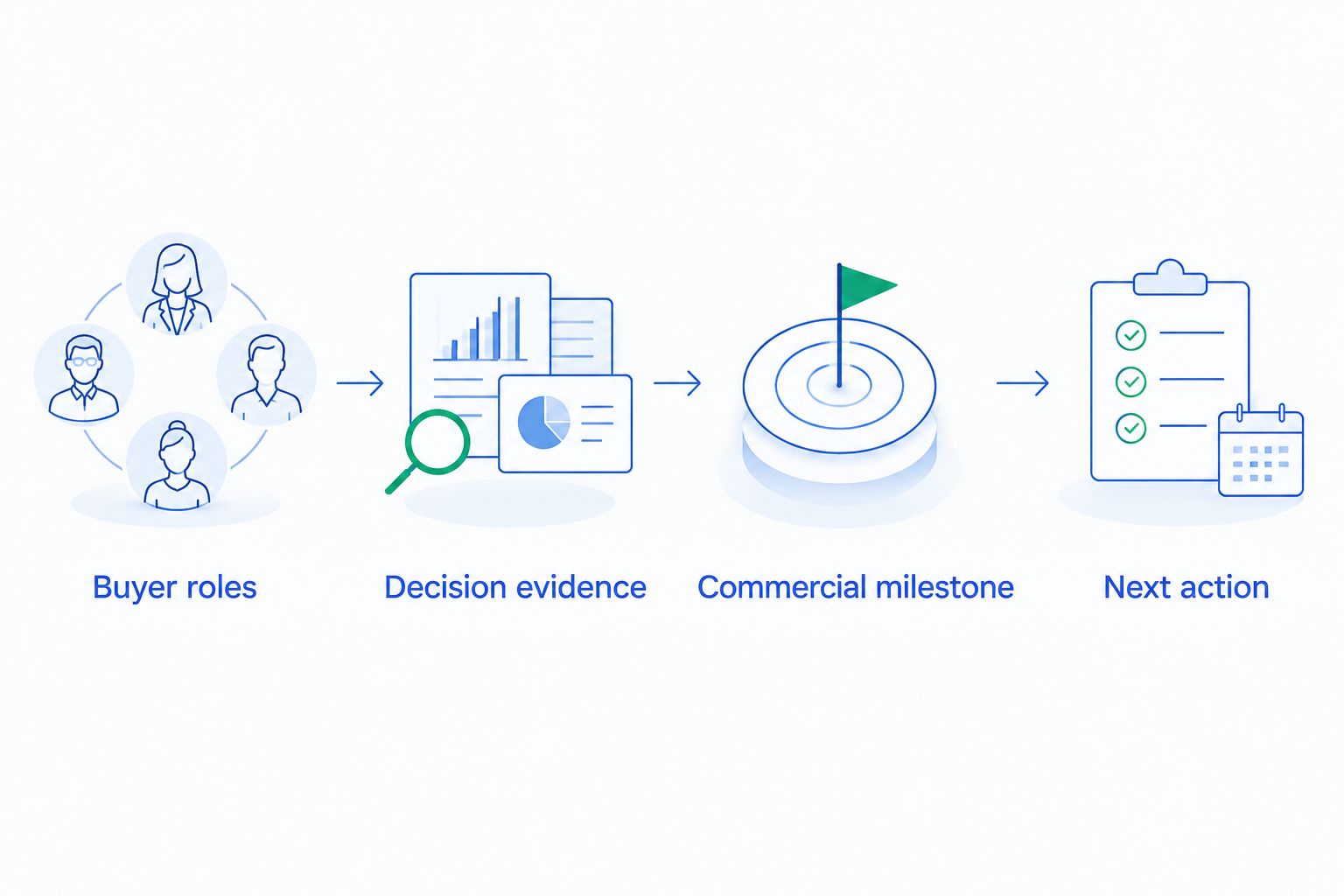
Evaluate the customer decision before judging the dashboard.
Separate account data from sensitive patient information. Do not treat a general CRM recommendation as confirmation that a particular deployment is suitable for protected health information. Have the appropriate legal, privacy, and security reviewers assess your intended data use, agreements, access controls, and integrations.
When commercial strategy should come first
If every opportunity stalls for a different reason, examine the commercial assumptions before changing systems. Review whether you can name the buyer, the budget, the reason to act, and the evidence required for a purchase decision.
Consider this hypothetical example: a clinician likes the device, but the founder cannot identify who funds adoption. Adding the contact to a new pipeline improves recordkeeping; it does not resolve the funding question.
R-Terra Consulting's commercialization and positioning work addresses that upstream decision. For founders evaluating a paid two-week commercial diagnostic, the engagement path begins with a 15-minute fit call, followed by a technical session and clear next steps. The diagnostic is a paid engagement, not a free assessment.
Before that conversation, prepare your current positioning, active opportunities, recurring objections, and the buying decisions you cannot explain. Use the discussion to assess whether commercial diagnosis is the right next investment rather than assuming software replacement is necessary.
Assess your commercial next step
Start with a 15-minute fit call, followed by a technical session and clear next steps.
Explore commercialization consulting
Which medical device sales CRM should you choose?
Choose Salesforce Sales Cloud as the default shortlist leader when complex account relationships are your defining requirement. Choose Microsoft Dynamics 365 Sales for Microsoft-centered operations, HubSpot Sales Hub for marketing-to-sales coordination, or Pipedrive for focused opportunity management.
For a founder without repeatable acquisition, make the more consequential decision first: establish whether the bottleneck is commercial uncertainty or sales administration. Your 2026 CRM purchase should support an understood buying process, not postpone defining one.
FAQ
What's the best CRM software for medical device sales teams?
Salesforce Sales Cloud is the default shortlist leader for medical device teams managing complex account relationships. Microsoft Dynamics 365 Sales, HubSpot Sales Hub, and Pipedrive fit different operating priorities, so evaluate each against a defined buying process.
Is Salesforce better than HubSpot for medical device sales?
Salesforce Sales Cloud is the stronger shortlist starting point when complex account modeling is the main requirement; HubSpot Sales Hub suits marketing-to-sales coordination. Demonstrate the same institutional opportunity in both before deciding.
Should a medical device startup choose Pipedrive?
Pipedrive belongs on the shortlist when a startup needs focused deal tracking and has a defined sales process. Verify that its proposed configuration represents the stakeholders and buying milestones your team actually manages.
Does Microsoft Dynamics 365 Sales make sense if we already use Microsoft?
Microsoft Dynamics 365 Sales deserves evaluation when your sales workflow is intended to fit a Microsoft application environment. Existing Microsoft use alone does not establish CRM suitability or confirm the required integrations.
Can a CRM fix stalled medical device sales?
A CRM can organize ownership, activity, and opportunity information, but it cannot resolve an undefined buyer or purchasing rationale. Diagnose whether stalled sales reflect weak coordination or an unanswered commercial question before replacing software.
Can we store patient information in a medical device sales CRM?
Do not assume a CRM is suitable for patient information from its inclusion in a sales software shortlist. Review the specific deployment, intended data, contractual requirements, access controls, and integrations with qualified privacy and security reviewers.
Does R-Terra Consulting sell CRM software?
R-Terra Consulting provides commercialization and positioning strategy consulting, not CRM software. Its engagement path starts with a 15-minute fit call, then a technical session and clear next steps; its two-week commercial diagnostic is paid.
One last thing
Before signing a CRM agreement, ask a salesperson to explain a stalled opportunity using only its customer record. Look for the buyer, the unresolved decision, the evidence required, and the next commitment.
If those details are absent, determine whether the system cannot represent them or the team does not yet know them. Replace software for the first problem; resolve commercial strategy for the second.
Want this applied to your company?
Start with a brief 15-minute discovery call to confirm fit.
Discuss Your Project